The European market remains one of the main destinations for manufacturers of medical devices from countries such as India, China, South Korea, Turkey, the United Arab Emirates, and any other country outside the European Union. However, marketing a medical device in Europe requires compliance with Regulation (EU) 2017/745 (MDR), one of the most stringent regulations internationally.
For many international manufacturers, the main challenge lies not only in obtaining CE marking, but also in understanding what documentation they must prepare, what tests they must conduct, and how to demonstrate that their medical device meets all regulatory requirements.
In this article, we explain the main obligations imposed by the MDR on non-European manufacturers and how a proper validation strategy can reduce certification times and facilitate access to the European market.
Who does the MDR consider to be a manufacturer outside the European Union?
For the purposes of the MDR, a manufacturer outside the European Union is defined as any company whose registered office is located outside the territory of the European Union and that intends to place a medical device on the market within the European Economic Area.
Among them are manufacturers based in:
- India
- China
- South Korea
- Japan
- Singapore
- Malaysia
- Vietnam
- United Arab Emirates
- Saudi Arabia
- Turkey
- United Kingdom (for products with CE marking)
All of them must meet exactly the same technical and regulatory requirements as a European manufacturer.
Manufacturer’s Main Obligations Under the MDR
Although the process may vary depending on the medical device’s classification, there are a number of common requirements.
Appoint an EU Authorized Representative
Every manufacturer established outside the European Union must appoint an Authorized Representative with a registered address in a Member State.
This representative will serve as the official point of contact with the competent authorities and will assume certain regulatory responsibilities as defined in Article 11 of the MDR.
Implement a Quality Management System
The manufacturer must have a system in place to ensure control over all phases of the medical device’s life cycle:
- design and development;
- shopping;
- production;
- quality control;
- document management;
- claims processing;
- corrective actions;
- post-marketing surveillance.
In practice, most manufacturers choose to obtain ISO 13485 certification, as it is the international benchmark standard for this type of organization.
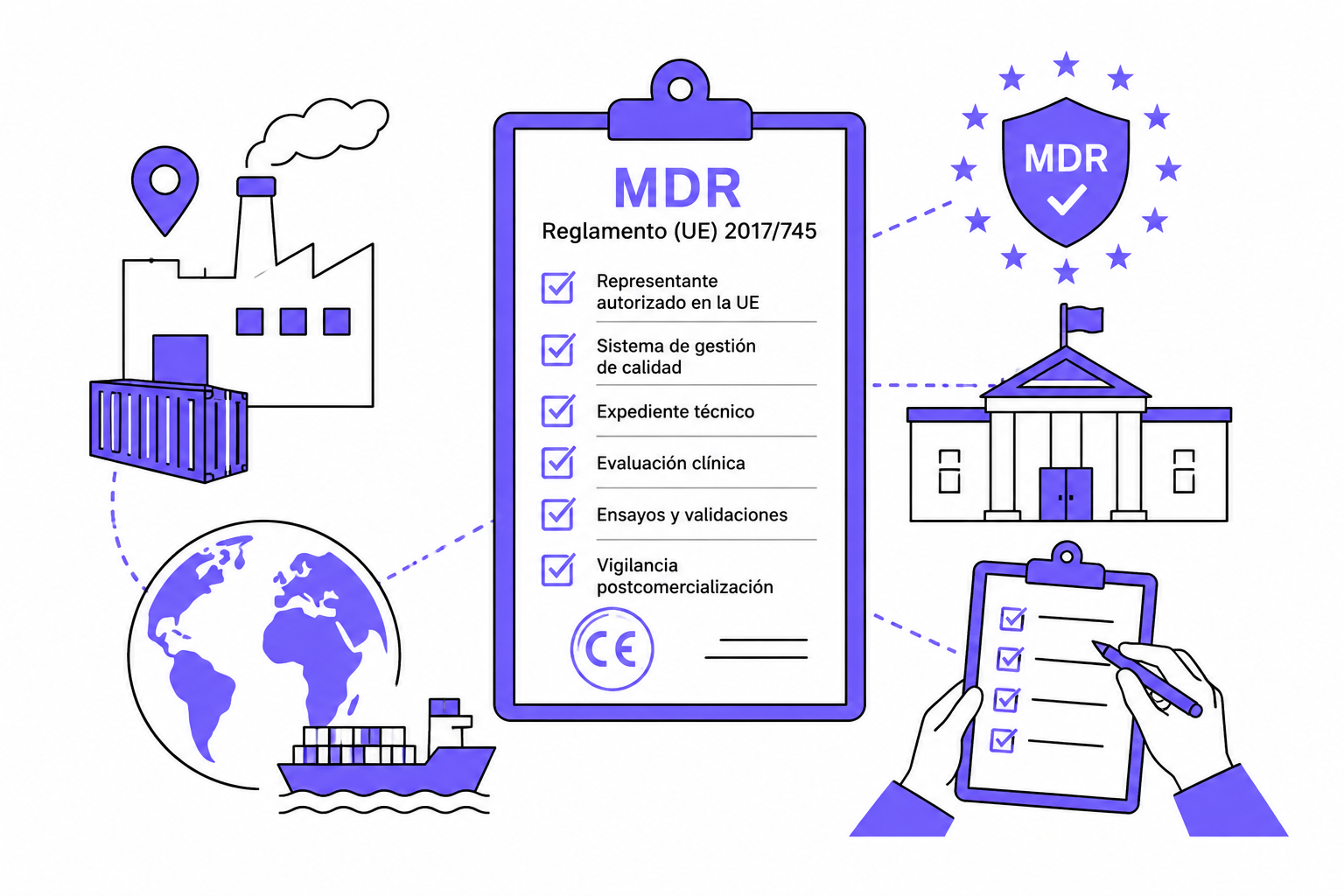
Prepare a complete technical dossier
One of the most significant changes introduced by the MDR is the level of detail required in the technical documentation.
The file must include, among other things:
- product description;
- intended purpose;
- technical specifications;
- risk management;
- clinical evaluation;
- biological validation;
- test reports;
- tagged;
- instructions for use;
- evidence of compliance with applicable regulations.
All of this documentation must be kept up to date throughout the product’s commercial life.
Mechanical testing: an essential part of MDR compliance
For implantable medical devices and devices subjected to mechanical stress, testing is a fundamental part of the technical evidence.
Depending on the type of product, the following may be required:
- fatigue tests;
- static tests;
- flexural tests;
- wear tests;
- corrosion tests;
- coating adhesion tests;
- biomechanical assessment;
- functional validation.
These tests are typically conducted in accordance with international standards such as:
- ISO 14801
- ISO 7206
- ASTM F382
- ASTM F543
- ASTM F1160
The selection will depend on the type of medical device and its intended use.
Why is it recommended to have testing performed at an ISO/IEC 17025-accredited laboratory?
The MDR does not require that all tests be conducted in accredited laboratories.
However, in practice, Notified Bodies place greater trust in reports issued by laboratories accredited under ISO/IEC 17025, especially when it comes to implantable medical devices.
Our guide on working with a European testing laboratory explains what accreditation adds, how to ship samples and what information is needed to request a proposal.
The main benefits are:
- proven technical expertise;
- validated test methods;
- metrological traceability;
- greater international acceptance;
- reduction in the number of observations during certification.
For manufacturers located outside Europe, this represents a significant advantage when submitting the technical dossier.
Common Mistakes Made by International Manufacturers
During certification processes, it is common to encounter problems such as the following:
| Common Mistake | Consequence |
|---|---|
| Tests conducted using outdated standards | Request to Repeat the Tests |
| Incomplete technical documentation | Delays in the evaluation |
| Lack of sufficient clinical evaluation | Additional Requirements of the Notified Body |
| Tests Not Aligned with the Intended Use | Review of the technical file |
| Regulatory strategy defined too late | Increased costs and lead times |
Proper planning from the earliest stages of development prevents most of these issues.
Recommended Strategy for Entering the European Market
A validation strategy is typically structured in several phases.
| Phase | Recommended Activities |
|---|---|
| Development | Initial Design Validation and Biomechanical Analysis |
| Prototype | Functional Testing and Optimization |
| Verification | Tests accredited in accordance with ISO and ASTM standards |
| Certification | Preparation of the technical dossier and clinical evaluation |
| Marketing | Post-Marketing Surveillance (PMS and PMCF) |
This approach reduces the risk of having to repeat tests and streamlines the CE marking process.
How Med-Lab IBV Helps Manufacturers Outside the European Union
Med-Lab IBV partners with international manufacturers seeking to bring their medical devices to the European market through:
- accredited mechanical testing;
- biomechanical assessment;
- implant validation;
- interpretation of ISO and ASTM standards;
- technical support for regulatory documentation.
The combination of biomechanical expertise, regulatory knowledge, and testing capabilities enables us to generate solid technical evidence to facilitate the certification process.
You can learn more about our services at the Implant Testing Laboratory, where we conduct accredited testing for manufacturers of medical devices seeking CE marking.
A good regulatory strategy begins long before applying for CE marking
Many delays in certification do not occur during the Notified Body’s review, but rather during the initial stages of product development.
Properly planning testing, selecting the applicable standards, and generating robust technical evidence from the outset helps reduce costs, speed up certification, and increase the likelihood of successfully entering the European market.
If your company manufactures medical devices outside the European Union and wishes to market them in Europe, Med-Lab IBV can help you develop a validation strategy tailored to the requirements of the MDR.