The exoskeletons have established themselves as one of the most innovative technologies in the field of applied biomechanics, with remarkable growth both in clinical rehabilitation and in industrial and healthcare environments. These devices, designed to assist or increase human motor capacity, combine mechanical engineering, electronic control and in-depth knowledge of human movement.
However, their increasing adoption poses a key challenge: how to technically and clinically validate these complex systems and how to certify them according to current European regulations. In this article we analyze the main types of exoskeletons, their most relevant applications and the challenges associated with their certification as medical devices.
Types of exoskeletons according to design and functionality
Exoskeletons can be classified according to different technical and functional criteria, which directly influences testing and certification requirements.
Passive exoskeletons
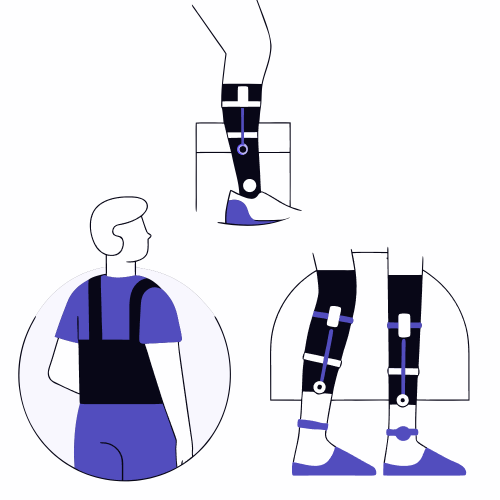
They do not incorporate actuators or active control systems. They use mechanical elements such as springs, shock absorbers or elastic structures to redistribute loads and reduce the user’s physical effort. They are common in occupational risk prevention and postural assistance.
Active exoskeletons
They integrate motors, sensors and control algorithms that actively assist movement. They are mainly used in neurological rehabilitation, spinal cord injury and gait support. Their technical complexity requires much more extensive validation.
Hybrid exoskeletons
They combine passive and active elements, seeking a balance between mechanical simplicity and motorized assistance. Their use is growing in outpatient clinical applications.
Main applications of exoskeletons
The versatility of these devices has allowed their adoption in multiple sectors.
Clinical rehabilitation
In hospitals and rehabilitation centers, exoskeletons are used for:
- gait re-education after stroke,
- rehabilitation of spinal cord injuries,
- treatment of neuromuscular pathologies,
- improvement of mobility in geriatric patients.
In these cases, they are usually classified as medical devices under MDR 2017/745, which implies strict safety and clinical evidence requirements.
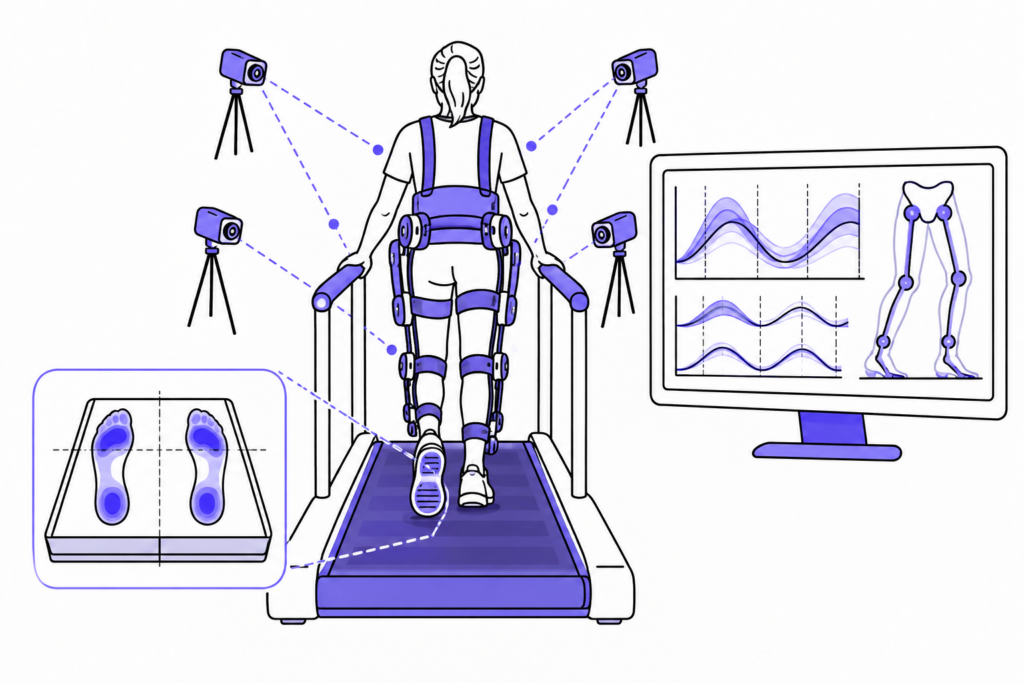
The Lokomat case study shows how biomechanical gait analysis helps build that evidence.
Functional assistance and personal mobility
Exoskeletons designed to facilitate activities of daily living for people with reduced mobility. Although they are not always used in clinical settings, they may fall within the medical regulatory framework depending on their purpose.
Industry and occupational ergonomics
In occupational risk prevention, exoskeletons reduce musculoskeletal loading in repetitive or load handling tasks. Their certification usually follows different regulatory frameworks, although the biomechanical principles of validation are similar.
Technical challenges in the validation of exoskeletons
Validation of an exoskeleton goes far beyond testing its structural strength.
Biomechanical complexity
The exoskeleton interacts directly with the human body. It is essential to evaluate:
- load distribution in joints,
- alignment with the anatomical axes,
- adaptation to different anthropometries,
- impact on the kinematics and dynamics of motion.
Control and safety systems
In active exoskeletons, the algorithms must respond safely to:
- losses of equilibrium,
- sensor failures,
- power interruptions,
- unexpected user movements.
Durability and reliability
These devices are subjected to thousands of cycles of use. Fatigue tests on structures, joints and actuators are critical to ensure their long-term reliability.
Regulatory and certification challenges
From a regulatory standpoint, exoskeletons present a particularly complex scenario.
Classification as a medical device
When the exoskeleton is intended for therapeutic purposes, the manufacturer must demonstrate compliance with MDR 2017/745, which implies:
- risk management,
- clinical evaluation,
- post-marketing surveillance,
- complete technical documentation.
Lack of specific harmonized standards
There is currently no single ISO standard specific to exoskeletons. Therefore, certification is based on:
- general mechanical standards,
- electrical safety standards,
- customized biomechanical testing,
- clinical evaluation guidelines.
This reinforces the need to work with laboratories specialized in applied biomechanics, capable of designing ad hoc test protocols.
IBV’s role in the validation of exoskeletons
The Biomechanics Institute of Valencia has advanced infrastructures for:
- mechanical and fatigue tests,
- analysis of human movement,
- electromyography,
- functional evaluation with real users,
- technical support in regulatory processes.
This combination makes it possible to approach exoskeleton validation from a comprehensive perspective : technical, biomechanical and clinical, aligned with MDR requirements.