For a medical device manufacturer based outside the European Union, selecting a testing laboratory in Europe can be a strategic decision. It is not merely a matter of completing a mechanical test: the goal is to generate traceable technical evidence that is representative of the product and useful for the markets in which it is intended to be sold.
Proper planning ensures that studies are aligned with the intended use, risk management, and applicable regulations. It also helps prevent insufficient samples, unwarranted worst-case scenarios, or reports that do not address the evaluator’s questions.
In this guide, we review the factors that an international company should consider before contracting mechanical, biomechanical, or functional testing from a European laboratory.
Why Use a European Medical Device Laboratory?
International manufacturers may require capabilities that are not available in-house, such as static and fatigue testing systems, wear testing equipment, human motion analysis, or expertise in specific standards. Outsourcing these tests provides access to specialized equipment without having to invest in, maintain, or qualify it.
Working with a European laboratory can also facilitate the preparation of evidence for the European Union market. The laboratory can help translate the intended use and risks of the product into a verifiable protocol, although the responsibility for demonstrating compliance remains with the manufacturer.
For projects involving multiple countries, the main advantage is to design a trial strategy from the outset that identifies which results can be reused and which regulatory differences must be addressed separately.
Is it mandatory to conduct testing within Europe?
The European Medical Device Regulation does not generally require that all tests be physically conducted within the European Union. What matters is the quality and relevance of the evidence: the method used, the laboratory’s competence, the representativeness of the samples, the acceptance criteria, and the relationship to the identified risks.
Choosing a European laboratory can facilitate technical coordination with the MDR framework, relevant standards, and the documentation in the application dossier. However, the acceptance of the evidence will depend on the product, the method used, the scope of the testing, and the overall assessment by the manufacturer—in consultation with its notified body, if applicable. Location alone does not guarantee that a report will be sufficient. Before testing, it must be verified that the protocol is appropriate for the specific product and its regulatory strategy.
What Does ISO/IEC 17025 Accreditation Offer?
ISO/IEC 17025 establishes requirements regarding the competence of testing and calibration laboratories. Accreditation provides assurance regarding aspects such as staff qualifications, equipment calibration, metrological traceability, method validation, control of environmental conditions, and the reporting of results.
It is important to review the specific scope. Just because a laboratory is accredited does not mean that all of its methods are accredited. The manufacturer must verify whether the required test is included within the scope, which standard and version it covers, and whether there are any limitations related to the product, the load, or the configuration.
A test that is out of scope may still be technically valid if it addresses a specific need and the method is justified and validated. In that case, the report must clearly distinguish between which activities are accredited and which are not.
At Med-Lab IBV, ENAC ISO/IEC 17025 accreditation applies to testing of surgical implants within scope 519/LE 1105. Before commissioning a test, it is advisable to confirm with the laboratory whether the specific combination of product, standard, method, and configuration falls within that accredited scope.
What products can be tested in a specialized laboratory?
Capabilities depend on the laboratory and its equipment. In the fields of biomechanics and mechanics, the following topics, among others, can be addressed:
- Dental Implants and Their Connections.
- Joint prostheses, including hip prostheses and other configurations, the evaluation of which may be defined based on the product and the applicable protocol.
- Spinal systems, subject to the implant configuration, the necessary tools, and the applicable test protocol.
- Plates, screws, and other osteosynthesis systems.
- External prostheses, orthoses, and assistive devices.
- Wheelchairs and mobility solutions.
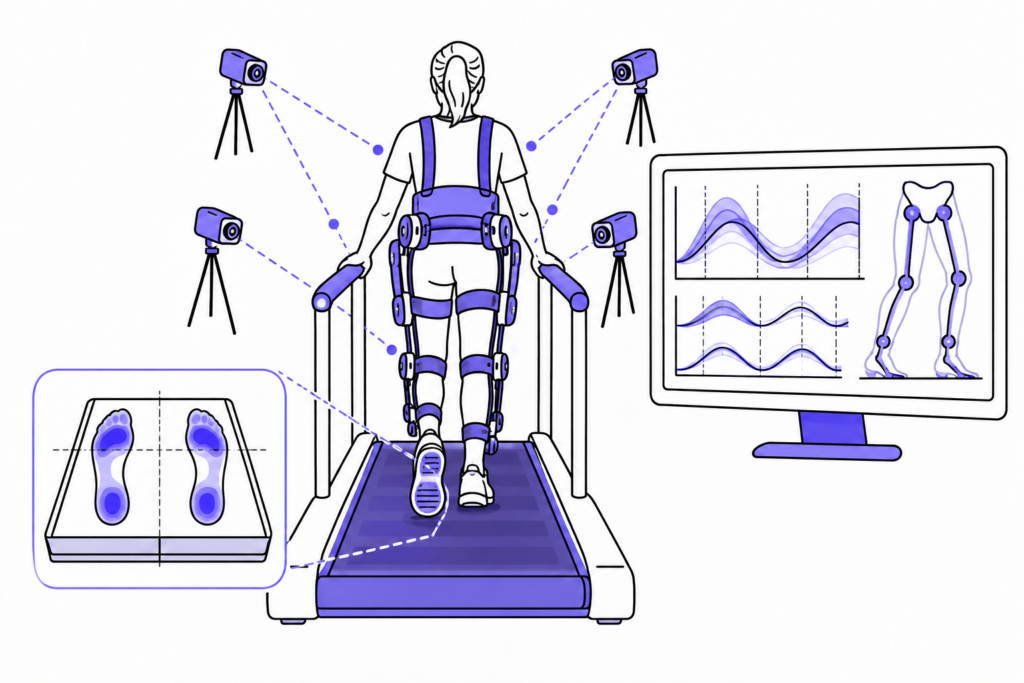
- Medical, assistive, and industrial exoskeletons.
- Rehabilitation technologies and devices that interact with human movement.
Med-Lab IBV combines capabilities in the testing of surgical implants, the evaluation of exoskeletons, and human motion analysis in the laboratory, as well as the testing of assistive products and devices, such as wheelchairs, orthoses, external prostheses, and other assistive devices.
Mechanical, Biomechanical, and Functional Testing: Differences
| Type of evaluation | What it allows you to study |
|---|---|
| Mechanical Testing | Strength, stiffness, fatigue, deformation, wear, or structural behavior. |
| Biomechanical Assessment | Interaction between the device, the body, and human movement. |
| Functional Test | Product performance under conditions representative of its intended use. |
| Person-Product Evaluation | Ergonomics, comfort, stability, effort, mobility, and user experience. |
| Custom Protocol | Risks or benefits that are not fully covered by a regulation. |
These approaches are not mutually exclusive. An exoskeleton may require structural verification as well as user testing. An implant may require static, fatigue, and wear testing, along with a worst-case analysis.
How to Select the Applicable Standards
A standard should not be selected based solely on the product’s name. Its applicability depends on the intended use, anatomy, design, materials, configurations, and risks. The manufacturer must document why a standard addresses the requirement to be verified and which aspects are not covered.
It is also necessary to confirm which edition applies in each market. A regulatory authority may recognize a different version or establish a transition period. When national differences exist, it is advisable to identify them before manufacturing the samples to avoid having to repeat the test.
If there is no standard that covers the relevant situation, a specific protocol may be developed. This protocol must define the purpose, setup, variables, sample preparation, number of samples, analysis, and acceptance criteria.
Can the results be reused in different markets?
Test data based on international standards may be included in submissions for various countries, but their reuse is not automatic. It is necessary to compare the accepted versions, regulatory specifics, and the characteristics of the product marketed in each jurisdiction.
A test result will have greater potential for reuse when the test sample is equivalent to the final product, the worst-case scenario is well-justified, the method is recognized, and the report contains sufficient information. Changes in materials, geometry, manufacturing, or sterilization must be evaluated to determine whether they affect the validity of the test.
Planning a multi-market strategy before launching the program can help reduce duplication. To do so, the manufacturer should inform the agency of all target countries and not limit the briefing to the first planned market.
Worst-Case Scenario Selection and Sample Preparation
Within a product family, testing all variants is rarely feasible. The selection of the worst-case scenario should be based on a technical analysis that takes into account geometry, size, material, connections, manufacturing, and loading conditions. The smallest reference is not necessarily the most unfavorable for all failure modes.
Samples must represent the configuration that will be marketed. When cleaning, conditioning, aging, or sterilization may alter performance, those conditions must be incorporated into the plan. Individual identification, lot numbers, and any incidents must be documented throughout the entire process.
What a Solid Test Report Should Include
A useful report for third parties should include, at a minimum:
- Identification of the manufacturer and the samples.
- Standard, version, and procedure applied.
- Conditioning and Testing Conditions.
- Equipment and measured variables.
- Results, units, and data processing.
- Measurement uncertainty, where applicable.
- Acceptance criteria and their origins.
- Deviations, Incidents, and Limitations.
- Enough illustrations to understand the assembly process.
- List of activities included in the accredited scope.
The report does not replace the manufacturer’s overall evaluation, but it should make it possible to determine what was tested, how it was tested, and what the results were.
International shipping of samples to a European laboratory
Transportation must be planned as part of the project. Before shipment, it is advisable to agree on the number of units, packaging, customs documentation, declared value, environmental conditions, and the need for tools or auxiliary components.
Samples must be clearly labeled and accompanied by drawings, assembly instructions, and a list of contents. If the test is destructive, it is advisable to have spare units available. When shipping sterile products or materials subject to restrictions, the applicable logistical requirements must be reviewed in advance.
Information Required to Request a Proposal
- Description and Intended Use of the Device.
- Countries where it will be sold.
- Expected regulatory classification.
- Standards and versions considered.
- Risks or benefits that must be verified.
- Models, sizes, and configurations in the product line.
- Preliminary Justification for the Worst-Case Scenario.
- Availability and status of samples.
- Proposed acceptance criteria.
- Schedule and required report format.
Sharing this information from the outset makes it possible to identify gaps, prepare the necessary tools, and estimate the timeline and number of samples more accurately.
A technical partner for international manufacturers
IBV combines expertise in implant testing, biomechanical evaluation, human-product interaction, and the development of customized protocols. This combination allows us to work with both standardized methods and projects that require replicating specific conditions of use.
For a company located outside the European Union, working with a team capable of reviewing the approach before testing can reduce uncertainty and make the results more useful for product development and regulatory strategy.
Do you need to conduct trials in Europe from outside the EU?
At Med-Lab IBV, we help international manufacturers define protocols, select representative samples, and generate technically sound mechanical, biomechanical, and functional evidence.
Frequently asked questions about medical device testing in Europe
Can a manufacturer outside the EU hire a European laboratory?
Yes. An international manufacturer can commission testing from a European laboratory. It must make sure that the method, the samples and the report meet the requirements of its target markets.
Does the MDR require the device to be tested in Europe?
There is no general obligation to perform all testing physically in Europe. What matters is that the evidence is adequate, traceable and representative, and that it addresses the intended use and the risks of the device.
What does an ISO/IEC 17025 accredited laboratory add?
Accreditation provides confidence in technical competence, metrological traceability, equipment calibration, method validation and control of results. You should check that the specific test is included in the laboratory's scope.
Can the same tests be used in several countries?
In some cases, yes, especially when international standards are applied. Reuse depends on the recognised versions, national differences, the device configuration and the requirements of each authority.
What should the manufacturer send to request a proposal?
The intended use, target markets, standards being considered, risks to be verified, product family, preliminary worst-case selection and sample availability.
How are samples shipped from outside the European Union?
Shipping must be coordinated with the laboratory, defining packaging, identification, customs documents, transport conditions, fixtures and spare units before the samples are dispatched.