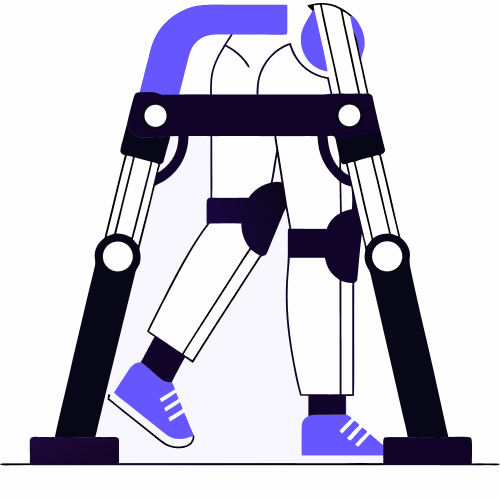
The rehabilitation exoskeletons have become a key tool for patients with spinal cord injuries, strokes, or musculoskeletal conditions. To ensure their therapeutic efficacy and safety, rigorous technical and clinical validation is essential, in accordance with medical device regulations.
In this article we discuss how exoskeletons are evaluated, what tests are required and why Med-Lab IBV is the reference laboratory for this emerging technology.
What are the regulatory requirements for exoskeletons?
Depending on their use, exoskeletons can be classified as:
Medical devices under MDR 2017/745 (clinical rehabilitation)
Assistive equipment to support mobility
Systems for occupational risk prevention
In all cases they must meet the requirements of:
Biomechanical safety
Ergonomics
Stability
Structural reliability
Functional evaluation with users
Medical exoskeletons also require clinical evaluation and postmarketing evidence.
Essential technical tests
Exoskeletons must pass tests that guarantee their mechanical behavior:
Structural strength and fatigue tests
Validate the durability of joints, actuators and structures.
Load and weight distribution tests
They analyze the effect of the device on the limbs and spine.
Stability tests
They check the behavior in the event of imbalances or abrupt changes in posture.
Thermal comfort and ergonomics tests
They evaluate pressure points, temperature and adaptability to the body.
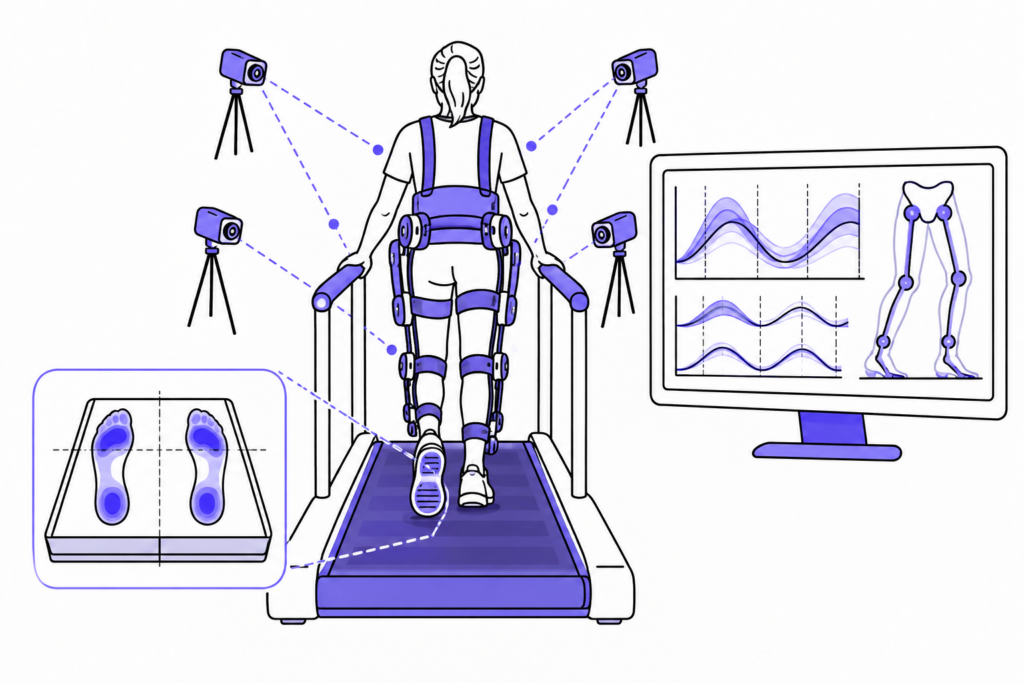
Advanced biomechanical evaluation and motion analysis
In addition to structural and functional testing, validation of a rehabilitation exoskeleton requires understanding how it interacts with the human body during actual movement. For this purpose, advanced biomechanical analysis techniques are used to evaluate:
Three-dimensional kinematics of motion
The 3D capture systems record limb trajectory, gait symmetry and joint amplitude, detecting possible compensations or restrictions induced by the exoskeleton.
A practical example is the use of gait analysis to measure the outcomes of robotic rehabilitation with Lokomat.
Dynamics of forces and joint moments
By means of force platforms and inertial sensors, the loads transmitted to the joints are quantified. This is essential to avoid overloading the knee, hip or lumbar spine.
Muscle activity by electromyography (EMG)
EMG analyzes which muscles are activated when the user uses the exoskeleton, making it possible to determine:
- if there is adequate assistance to the movement,
- if muscle fatigue is reduced,
- or if the exoskeleton induces undesired activation patterns.
Assessment of motor control and postural stability
The exoskeleton algorithms must respond to variations in the user’s balance. Postural analysis makes it possible to validate the accuracy of these control systems in the face of real disturbances.
These techniques not only provide essential data for clinical safety, but also allow manufacturers to optimize the design of the exoskeleton, adjust assistance algorithms and improve the comfort and reliability of the system. At Med-Lab IBV, this evaluation is carried out in an environment equipped with motion analysis technology of international reference, integrating all biomechanical parameters in interpretative reports that facilitate certification under MDR.
More information in our exoskeleton testing laboratory